Melbourne Sun times
| Date | Rise | Set | Day Length | Solar Noon* | |
| Sunday 1st | 6:33am | 8:33pm | 13:59 hrs | 1:33pm | |
| Wednesday 11th | 6:44am | 8:23pm | 13:38 hrs | 1:34pm | |
| Saturday 21st | 6:55am | 8:11pm | 13:15 hrs | 1:33pm | |
| Saturday 28th | 7:03am | 8:01pm | 12:58 hrs | 1:32pm |
*When the sun is at its highest, crossing the meridian or local longitude.
Moon Phases
| Full Moon | Tuesday | 3rd |
| Third Quarter | Monday | 9th |
| New Moon | Tuesday | 17th |
| First Quarter | Tuesday | 24th |
Moon Distance
Wednesday 11th is lunar apogee (furthest from Earth) at 404,576 km.
Wednesday 25th is lunar perigee (nearest to Earth) at 370,135 km.
Planets
Mercury, after its recent solar conjunction, is a ‘daytime planet’ too close to the Sun to be visible.
Venus is also a ‘daytime planet’ after its solar conjunction and so not visible this month.
Mars will shortly have its solar conjunction passing behind the Sun and will not be visible this month either.
Jupiter continues to be clearly visible this month from 8:30pm in the north-east at dusk. It will move across the northern sky during the night before fading in the north-west by 3am and a little earlier each night during the month.
Saturn remains visible early in the month low in the west at dusk before setting at around 10pm, but by mid-February as it approaches solar conjunction it will disappear from our night skies.
Meteors
The alpha-centaurids and beta-centaurids are active from 2nd to 25th peaking on the 8th. They are different but it is difficult to distinguish between them. Occurring low in the south near the Two Pointers, they are not strong showers but often have fireballs and persistent trails. 25 per hour can occur but six per hour has been more usual.
See:
TheSky.com – Alpha Centaurids
Stars and constellations
In the East
High in the sky is Sirius, the brightest star at night and the principal star in Canis Major (Greater Dog). This is one of Orion’s two hunting dogs which is why Sirius is also referred to as The Dog Star. Directly below Sirius is the star Procyon which marks the location of Canis Minor, Orion’s smaller dog.
Many cultures have recognised the first evening appearance of Sirius as marking a special time during the year for religious, agricultural or other reasons. It sits 8.6 light years away making it the fifth nearest system to us and its energy output reflects a name appropriately derived from the Greek seirios, meaning glowing or scorching.
Sirius is, however, a binary system. Sirius A is twice the mass of our sun, almost 17 times as large and 25 times as luminous. Small faint Sirius B - seen using telescope imaging than masks brighter Sirius A - is a white dwarf about the size and mass of the Earth and the remnant core of a star that was once similar to our sun. Sirius A and B orbit their mutual centre of mass every 50 years.
In the North to North-West
Directly north lies Orion, the hunter, seen in the southern hemisphere upside down. The famous three stars of his belt are Mintaka, Alnilam and Alnitak.
From his belt and to the upper right is a line of stars forming his scabbard in the centre of which is the beautiful Orion Nebula, a vast stellar nursery 1500 light years from us. To upper left in Orion is the blue-white supergiant star Rigel (one of his feet) and lower right is the red supergiant Betelgeuse (one of his shoulders).
Orion’s three belt stars also mark the base of the southern hemisphere’s Saucepan asterism.
To the north-west is the open star cluster the Hyades 153 light years away. It appears as a wedge or inverted V and forms the head of Taurus, the bull. At its lower right corner sits the red-giant star Aldebaran, a much closer star at 65 light years.
To the left is the Pleiades, a close cluster of young blue stars 400 light years from us. These stars formed together and are generally bound together under their mutual gravitational attraction, although over millions of years it is expected the cluster will disperse. Also known as The Seven Sisters for the number that might be seen with the naked eye. In some traditions the cluster represents a group of women.
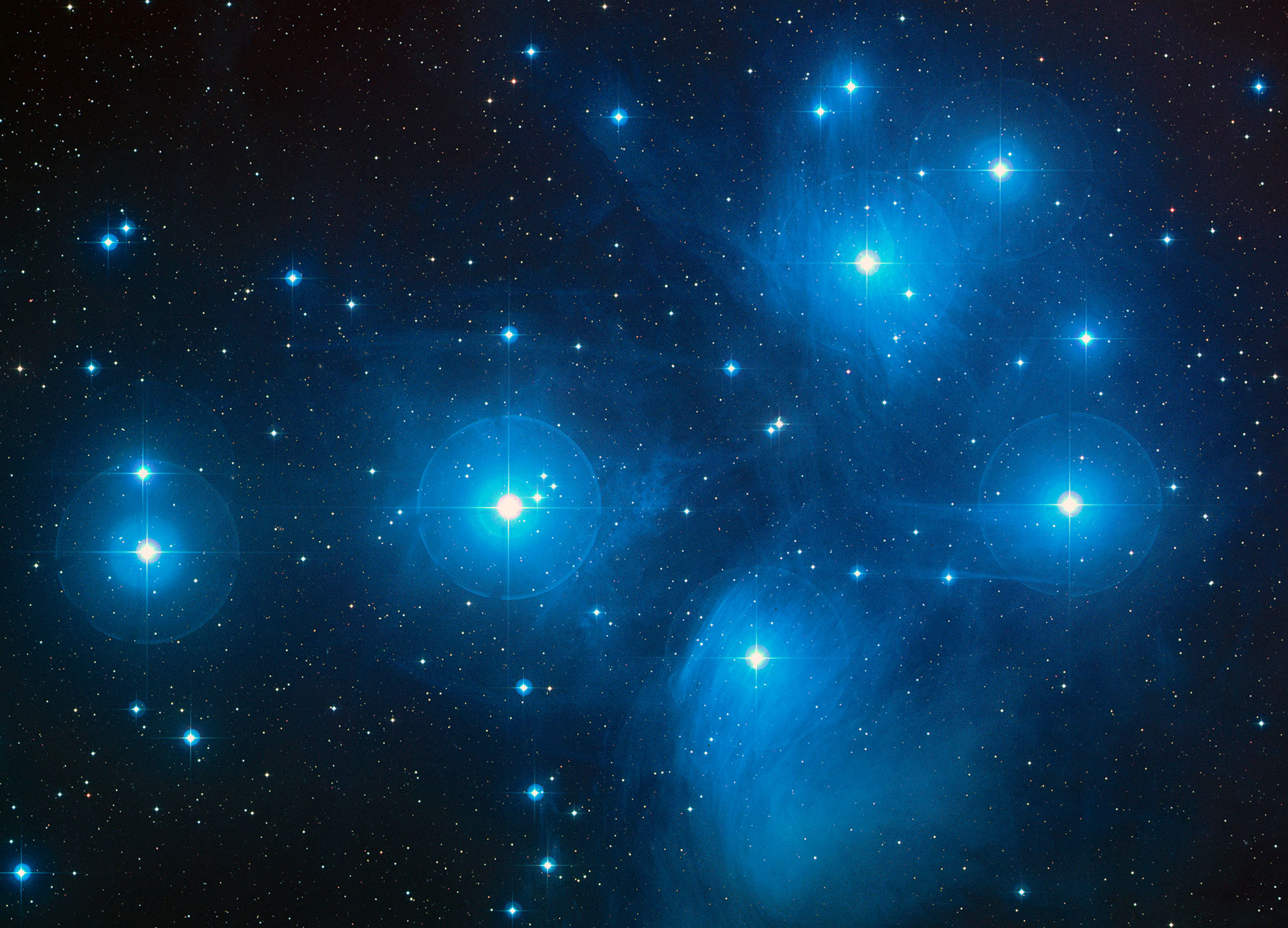
Learn more:
NASA Pleiades
In the South-East to South-West
The Southern Cross and the Two Pointers, (Alpha & Beta Centauri) are low in the south-east. In the south-west are the two small nearby galaxies, the Magellanic Clouds, named in honour of 16th century explorer Ferdinand Magellan who embarked on the first circumnavigation of the globe. They look like faint fuzzy patches but are best seen away from city lights. The earliest known physical depictions of them are in petroglyphs in South America.
Arcing across the night sky, and slowly wheeling as the Earth rotates during the night to the east, is the majestic Milky Way - billions of distant stars of our galaxy.
In visible light our view of the galaxy is largely restricted to our local spiral arm which is one of several that sit in the disc of the galaxy. We are looking ‘edge on’ into the flat disc of billions of stars. By contrast, the two darker sides of the night sky a view out of the galactic plane. In those directions we seen far fewer stars for a few thousand light years before intergalactic space begins.
International Space Station
ISS orbits every 90 minutes at an average distance of 400 km. It appears like a bright star moving slowly across the night sky.
Some bright passes are below for the Melbourne region.
On Thursday 5th, ISS passes overhead twice. First in the early morning and then again in the late evening.
Morning
Thursday 5th 5:27am to 5:33am, South-West to North-East
Evening
Thursday 5th 10:08pm to 10:13pm, North-West to South-East
Thursday 26th 9:16pm to 9:21pm, West-South-West to North-North-East
Friday 27th 8:26pm to 8:33pm, South-West to North-East
Heavens Above gives predictions for visible passes of space stations and major satellites, live sky views and 3D visualisations. Be sure first to enter your location under ‘Configuration’.
On this day
| 1st 2003 | The Space Shuttle Columbia (USA) disintegrated on re-entry killing all seven astronauts and halting the shuttle program for over two years. |
| 1st 1970 | US astronomer, Vera Rubin finds evidence of ‘dark matter’ by studying motion of stars and galaxy rotation not consistent with Newton’s laws. |
| 3rd 1966 | The Luna 9 (USSR) made first soft-landing on moon and sent first panoramic images from the Ocean of Storms. |
| 4th 1967 | The Lunar Orbiter 3 (USA) launches to the moon to select Apollo landing sites. |
| 5th 1963 | Dutch astronomer Maarten Schmidt discovers quasars (quasi-stellar radio sources). |
| 7th 1979 | Pluto moves inside Neptune’s orbit for the first time since its 1930 discovery. |
| 8th 1969 | The Allende meteorite, the largest carbonaceous meteorite found, lands near the village of Allende, Mexico. |
| 9th 1986 | The first module of Mir space station (USSR) is launched into Earth orbit. |
| 9th 1986 | The last visit of Comet Halley met by flotilla of probes (notably ESA’s Giotto) with comet’s next return due mid-2061. |
| 9th 1473 | The birth of Nicholas Copernicus, famous for his sun-centred theory in On the Revolutions of the Celestial Spheres (1543) which triggered the Copernican Revolution. |
| 9th 1975 | The Soyuz 17 (USSR) returns to earth setting Soviet record of 29 days in space. |
| 11th 2003 | The first measurements using WMAP (Wilkinson Microwave Anisotropy Probe) data to reveal relic Big Bang temperature as a variation across the universe. |
| 12th 1947 | 100-tonne iron meteorite falls in Sikhote Alin, southeast Russia. Largest in recorded history, brighter than the sun, with deafening sound and a smoke trail lasting several hours. |
| 12th 1961 | The Venera 1 probe (USSR) launched to Venus by Soviet Union. |
| 12th 2001 | The NEAR Shoemaker (USA) is first probe to land on an asteroid - 433 Eros. |
| 13th 2004 | The discovery of ‘largest diamond’, white star BPM 37093, is announced. |
| 14th 1990 | The Voyager 1 (USA) takes famous ‘pale blue dot’ picture of Earth as it looks back while speeding out of solar system. |
| 15th 1564 | The birth of astronomer, physicist and engineer Galileo Galilei in Pisa, Italy. Supported heliocentric solar system, and studied motion, telescopes, moons of Jupiter, rings of Saturn, phases of Venus, Sun spots, and features of the moon. |
| 15th 2013 | 20-metre Chelyabinsk meteor explodes 30km over Southern Urals, Russia, travelling at 60,000kph with shock wave damaging buildings and causing many injuries due to flying glass. |
| 16th 1771 | Charles Messier’s catalogue of 100 deep space objects. |
| 17th 1965 | The Ranger 8 (USA) probe launched to image the moon in aid of Apollo landings. |
| 18th 1930 | Clyde Tombaugh (USA) discovers Pluto using a blink comparator in a systematic search for the supposed ‘Planet X’ beyond Neptune. |
| 20th 1962 | The first American astronaut into orbit, John Glenn, in Mercury Friendship 7 in three orbits lasting almost 5 hours. |
| 22nd 1632 | Galileo publishes Dialogue Concerning the Two Chief World Systems which compared solar system models and led to conflict with and censure by the Catholic Church. |
| 23rd 1987 | SN1987A, closest and brightest supernova since 1054 observed in Large Magellanic Cloud 168,000 light years away. Visible to naked eye for months. |
| 24th 1968 | Post-graduate student, Jocelyn Bell (Northern Ireland) discovers first pulsars. |
| 26th 1966 | The first Saturn 1B rocket launch, which led to Saturn V Apollo missions. |
| 27th 1942 | JS Hey (UK) discovered radio emissions coming from the Sun. |
| 28th 1997 | The first evidence for gamma ray bursts (GRB) as extra-galactic energy sources. |