Melbourne Sun times
| Date | Rise | Set | Day Length | Solar Noon* | |
| Saturday 1st | 6:13am | 7:54pm | 13:41 hrs | 1:03pm | |
| Tuesday 11th | 6:03am | 8:05pm | 14:02 hrs | 1:04pm | |
| Friday 21st | 5:55am | 8:16pm | 14:20 hrs | 1:06pm | |
| Sunday 30th | 5:52am | 8:25pm | 14:33 hrs | 1:08pm |
*When the sun is at its highest, crossing the meridian or local longitude.
Moon Phases
| Full Moon | Thursday | 6th |
| Third Quarter | Wednesday | 12th |
| New Moon | Thursday | 20th |
| First Quarter | Friday | 28th |
Moon Distance
Thursday 20th is lunar apogee (furthest from Earth) at 406,691 km.
Thursday 6th is lunar perigee (nearest to Earth) at 356,833 km.
Planets
Planets
Mercury is planet closest to the Sun is visible in the evening in the west from 8:30pm until it sets in late twilight by 9:40pm.
Venus, our sunward close neighbour is too close to the Sun this month to be seen but will return to our night skies in late April.
Mars, the Red Planet is not visible this month as it is about to enter solar conjunction and move behind the Sun. Like Venus, it will reappear next April.
Jupiter, the largest planet in our solar system is bright and visible in the east from around 1am before fading in the north in dawn’s early light.
Saturn, this fainter but yellowish planet is visible this month in the evening from 8:40pm in the north-east after which it will move across the northern sky and before setting in the west by 3am. It will appear a little later each night as the month progresses.
Meteors
Two meteor showers occur this month, the Taurids and the Leonids, with up to 10-15 meteors per hour if viewed from a dark location.
The Taurids are bright, slow moving with colourful fireballs and occur in the first week of November in Taurus near the Pleiades star cluster and also near the red star Aldebaran.
The Leonids are high speed meteors that leave trains lasting several minutes. They appear in Leo which rises around 4am in the north-east from 13th - 20th but peak on the morning of the 18th. They arise from particles left by Comet Tempel-Tuttle as it orbits the Sun every 33 years, however the number of Leonid meteors has been declining over recent years with perhaps only 15 per hour.
Explore:
NASA Leonid News
EarthSky Leonid Shower
ESA About the Leonids
International Space Station
ISS orbits every 90 minutes at an average distance of 400 km appearing like a bright star moving slowly across the night sky. Here are some of the brightest passes expected this month over Melbourne and Central Victoria.
Morning
Thursday 6th 4:48am-4:53am North-West to South-East
Thursday 20th 4:00am-4:04am West to South-East
Evening
There are no bright evening passes this month.
Heavens Above gives predictions for visible passes of space stations and major satellites, live sky views and 3D visualisations. Be sure to first enter your location under ‘Configuration’.
Stars & Constellations
In the north
The constellation of Pegasus, the winged horse is in the north this month with Andromeda low in the north-west. Aquila (the eagle) and its principal star Altair (Alpha Aquilae) is in the north-west.
Low in the north this and next month is the Andromeda Galaxy (Messier 31 or M31), the furthest object visible to the naked eye at 2.5 million light years. A clear view to the northern horizon and being away from city lights is recommended. This large spiral galaxy contains perhaps 1 trillion stars and occupies an area in the sky larger than the moon. In four billion years our Milky Way and Andromeda may ‘collide’ and pass through each other with several subsequent encounters ultimately resulting in a merger into one large elliptical galaxy. Over time their co-orbiting central supermassive black holes may join to become one with significant gravitational waves generated by the event.
However, the nearby Clouds of Magellan, the smaller Triangulum spiral galaxy (M33), and concentrations of dark matter may exert enough gravitational influence to prevent a collision and merger.
Meet the neighbours - Andromeda and Triangulum
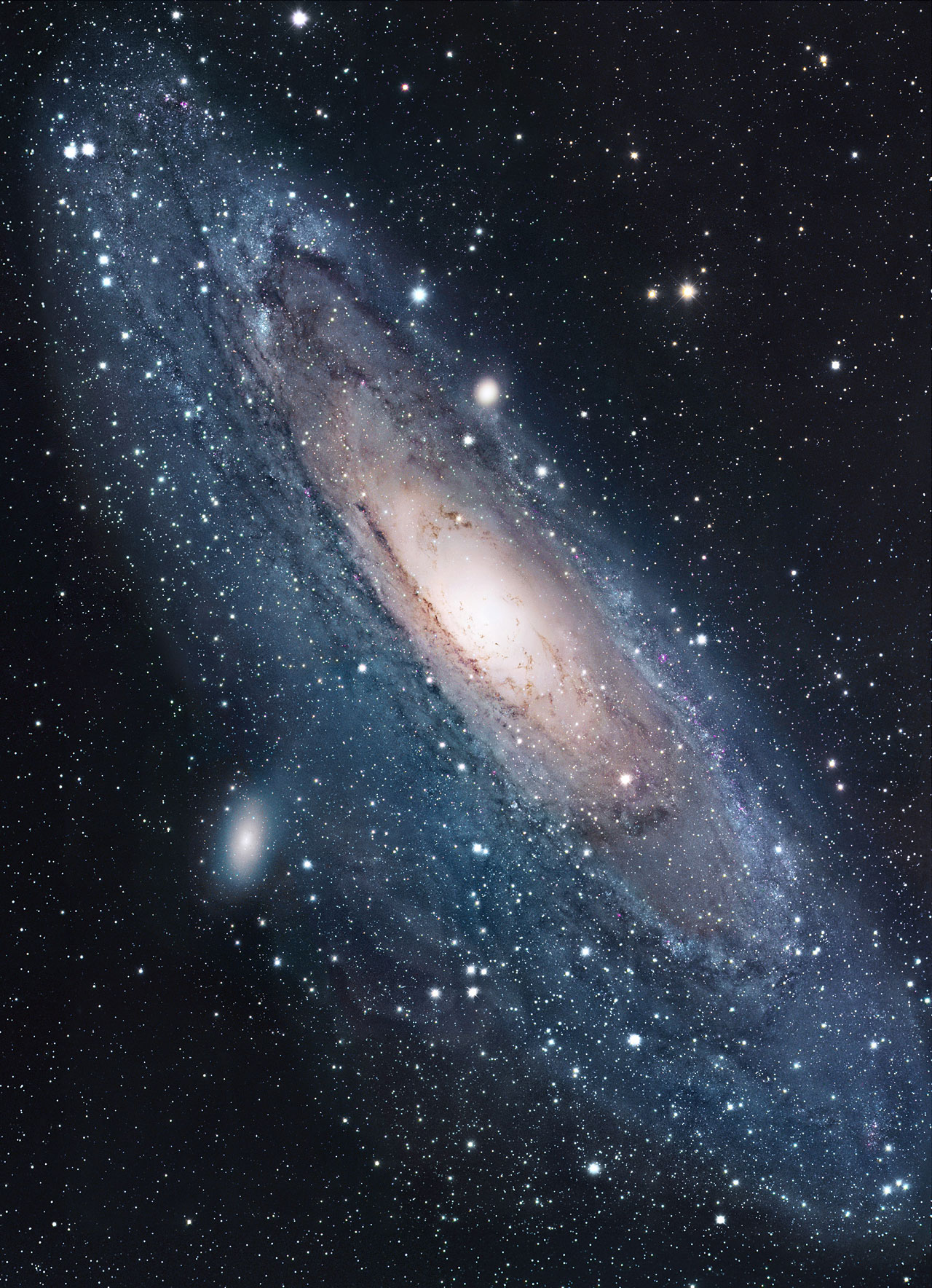

Our cosmic neighbourhood with these two spiral galaxies, plus perhaps 80 small faint galaxies, make up The Local Group which encompasses a volume of space of about 300 million cubic light years.
Explore:
NASA - Hubble Milky Way Collision
Science - Milky Way May Escape Collision
NASA Triangulum Galaxy M33
In the west
Spectacular Scorpius is now low in the west, soon to disappear from our evening skies. The red-giant star Antares (Alpha Scorpii) sits as the middle of three stars that form the arachnid’s body. Sagittarius, the centaur-archer, is above with its bow and arrow forming the well-known Teapot asterism. Higher up sits Capricorn, the sea goat, the hybrid fish-tailed goat.
In the east
Orion, the hunter, rises late in the evening this month, one foot being the blue-giant star Rigel (Beta Orionis) and a shoulder the red-giant star Betelguese (Alpha Orionis). The bright stars known as Orion’s Belt are Alnitak, Alnilam and Mintaka (and form the base of the Saucepan asterism), while Orion’s scabbard (the saucepan’s handle) hanging from his belt contains in its centre the beautiful Orion nebula - a vast gas cloud 1300 light years away where stars formation is occurring. Note that Orion appears upside down in the Southern Hemisphere.
Also, upside down is Taurus, the bull, with the red-giant star Antares (Alpha Scorpii), rising in the north-east later in the night. In the south-east past Orion is Canis Major, greater dog, and its star Sirius (Alpha Canis Majoris), the brightest star visible at night and also referred to as The Dog Star.
Approaching summer, the night sky from north-east to south-east will include a diverse range of features to enjoy.
In the south
Low in the south this month is Crux (Southern Cross) with the two Pointers, Alpha and Beta Centauri, to its right in the constellation Centaurus. In the south-east shines the second brightest star at night Canopus (Alpha Carinae), the principal star for the constellation Carina, the Keel.
The broad band of the Milky Way arcs from south-east along the western horizon to north-west. During the night as the Earth rotates to the east it will ‘wheel’ across the sky so that by 3am it will stretch from west to east.
On this day
| 1st 1963 | Then largest radio telescope, the Puerto Rico Arecibo Observatory, opens utilising a natural valley and transceiver suspended from pylons on nearby peaks. |
| 3nd 1957 | The Laika, a 3-year husky-Samoyd dog, became the first animal into orbit in Sputnik 2 (USSR). While never intended to return to Earth, she expired from heat stress after only a few hours. |
| 3rd 1973 | The Mariner 10 (USA) launches to Mercury, the first probe to use a gravitational ‘slingshot’ around a planet to reach an objective (in this case, Venus). |
| 4th 2003 | The largest solar flare recorded causes radio blackouts and saturates satellites, and was associated with a Coronal Mass Ejection (CME) many times larger than Earth leaving the Sun at 2,300 kph. |
| 8th 1656 | The birth of second Astronomer Royal Edmund Halley who calculated several historical comets to be the same. He successfully predicted its regular 76-year return. It posthumously carries his name. |
| 9th 1934 | The birth of American astrophysicist and science communicator Carl Sagan. |
| 12th 2014 | The first landing on a comet and direct surface images of Comet Churyumov-Gerasimenko by Philae lander from ESA’s Rosetta probe. |
| 12th 1980 | The Voyager 1 (USA) has historic close encounter with Saturn at 124,000km. It then flew by moon Titan which precluded going on to Uranus or Neptune, although both were later visited by Voyager 2. |
| 13th 1971 | The Mariner 9 (USA) is the first spacecraft to orbit another planet, Mars. Months of a planet-wide dust storm finally cleared to allow pictures of the surface. |
| 15th 1738 | Discoverer of Uranus and infrared radiation, William Herschel, is born. |
| 14th 2003 | Sedna, a TNO (Trans Neptunian Object) is discovered in a 11,400 year elongated orbit, one of the most distant objects known in the Solar System. |
| 16th 1965 | Venera 3 (USSR) is launched to Venus becoming the first probe to reach the surface of another world. |
| 16th 1974 | The first radio message sent into space (USA/Puerto Rico). ‘Arecibo Message’ to star cluster M13 25,000 light years away took 3 min. Its 1,679 binary 1’s and 0’s if arranged in 23 columns and 73 rows will reveal visual information (prime numbers 23 x 73 = 1,679). |
| 17th 1970 | Lunokhod 1 (‘Moon Walker’, USSR) first remote-controlled moon rover. Delivered by lander Luna 17, it drove 10km and lasted 321 Earth days, far longer than the expected 3 months. |
| 20th 1998 | First module for the ISS, Russia’s 12 metre Zaryu (‘Sunrise’) or Functional Cargo Block, is launched beginning a multi-module multi-year assembly of the space station in low Earth orbit. |
| 26th 2012 | The Curiosity rover (USA) arrives in Mars’ Gale Crater after a high-speed entry and first use of an innovative final landing technique – the ‘sky crane’. |
| 27th 1971 | The first probe to reach the Martian surface is Mars 2 (USSR) although it crashes in the process. |
| 27th 2001 | The first detection of composition of exoplanet’s atmosphere – by Hubble Telescope for planet Osiris orbiting a sun-like star 150 light years away. |
| 28th 1967 | Cambridge postgraduate student Susan Jocelyn Bell discovers the first pulsar, dubbed LGM1 for “little green men”. Its regular 1.3 sec radio pulse revealed it to be a rapidly spinning neutron star – the first of many to be identified. |
| 29th 1967 | Australia becomes the third nation after USSR, USA and France to launch a satellite from its own territory. The 45kg WRESAT-1 (Weapons Research Establishment Satellite) made 642 polar orbits until re-entry 11 days later. |
| 30th 1609 | Galileo studies the Moon with his improved telescope, and while not the first to do so he was the first to explain mountains and craters, and chart lunar features and their heights. |
| 30th 1954 | Ann Elizabeth Hodges of Alabama, USA, becomes the first person injured by a meteorite. She was badly bruised by a 5kg rock that crashed through her roof, deflected off a radio cabinet, and hit her while she was asleep on the couch. |